

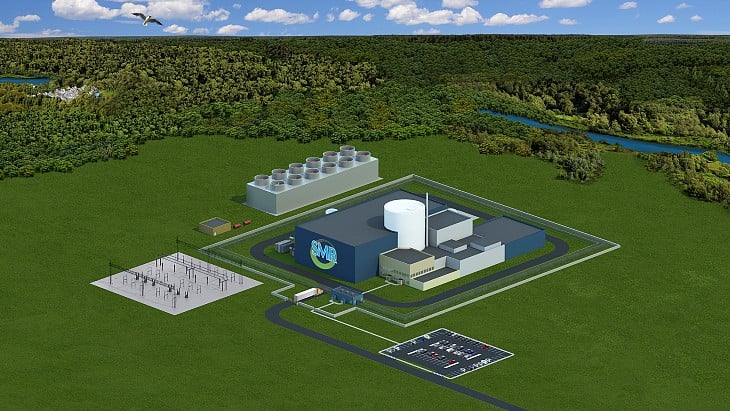
Appalachian Power has named its Joshua Falls property in Campbell County, Virginia, as the preferred site for a Small Modular Reactor (SMR), the company said in a Nov. 14 announcement. The utility plans to start the U.S. Nuclear Regulatory Commission’s Early Site Permit process and file with the Virginia State Corporation Commission in spring 2025. It also intends to apply for a share of the U.S. Department of Energy’s $900 million program to speed SMR deployment.
The site at Joshua Falls sits near the James River and already includes a 765-kilovolt substation with road access suitable for heavy equipment, according to Appalachian Power. The Virginia Department of Wildlife Resources maintains a public boat ramp there. The company says SMRs’ smaller footprint could open Nuclear energy projects in places that previously were not feasible and can be scaled to match demand.
“SMR technology is a key component to providing perfect power to our customers,” said Bill Fehrman, president and CEO of American Electric Power, Appalachian Power’s parent company. “Appalachian Power and AEP are committed to working with our states to develop energy solutions that align with state policy goals and reliably serve our customers.”
Virginia leaders linked the move to the state’s push for reliable, low-carbon power. “Advanced nuclear power is at the heart of Virginia’s All-American, All-of-the Above Energy Plan,” Gov. Glenn Youngkin said in the company’s release. “I am grateful that Appalachian Power is taking this next step to support Virginia’s nuclear future.” Appalachian Power President and Chief Operating Officer Aaron Walker added, “Appalachian Power is committed to generating clean, always-on power to meet Virginia’s future demand,” thanking the General Assembly and the governor for their support of SMR policy.
Community engagement begins soon. Appalachian Power will host an open house on Thursday, Dec. 5, 2024, from 5 to 7 p.m. at the Lynchburg Regional Business Alliance. There will be no formal presentation; residents can drop in to speak with company representatives and technical experts, the utility said. The company also plans to work with the Nuclear Regulatory Commission, state and local agencies, and other stakeholders to share information and gather feedback.
Lawmakers have been laying groundwork for SMRs. Earlier this year, Virginia’s House and Senate advanced measures aimed at early development and cost recovery for small reactors, including HB 1491 for Appalachian Power and SB 454 for Dominion Energy Virginia, according to industry reporting cited by the company. In 2023, Youngkin signed laws creating the Virginia Power Innovation Fund to support research on new energy technologies, and a program to expand nuclear education at Virginia colleges, according to the company announcement and local reporting.
Read More: Appalachia Economy Charts a Just Transition Beyond Coal
SMR output depends on design. The International Atomic Energy Agency notes SMRs are designed to produce up to 300 megawatts per unit and reports two are operating today, in Russia and China. Appalachian Power says some designs can reach up to 500 megawatts. George Porter, a company spokesperson, said the largest SMRs could power about 250,000 to 500,000 homes; any unit at Joshua Falls would serve Appalachian Power customers in Virginia.
Other utilities are exploring similar paths. Dominion Energy Virginia issued a request for proposals to assess the feasibility of an SMR at the North Anna Power Station in Louisa County. Dominion described the request as an evaluation step, not a commitment to build, according to reporting. In October, Amazon and Dominion agreed to explore potential SMR development at North Anna, local outlets reported.
Appalachian Power, a subsidiary of American Electric Power, serves about 550,000 customers across central and southwestern Virginia. If approvals and funding align, the Joshua Falls project would add round-the-clock Nuclear energy to the grid in Campbell County Virginia, supporting Virginia clean energy goals and the state’s long-term Energy plan.
